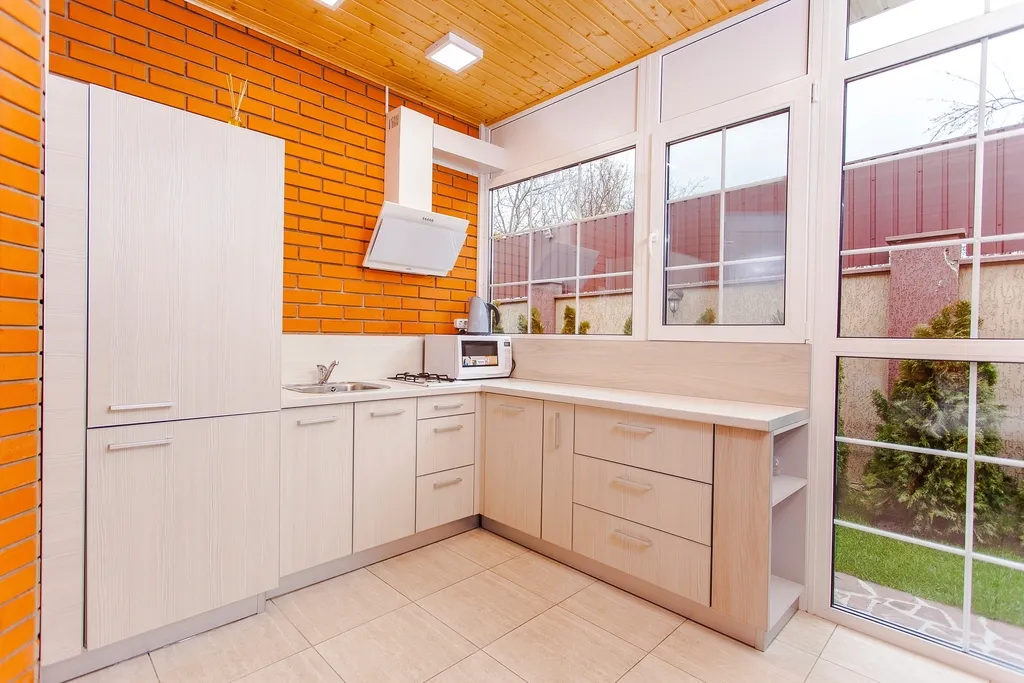
A small kitchen usually has more storage than it appears to. What it lacks is reachable storage — the shelf between waist and shoulder height that you can get to with one hand while holding something else.
Everything below is about moving the right things into that band.
Start by taking things out, not buying containers
The instinct is to buy organisers. The order that works is the reverse: empty a cupboard completely and put back only what has been used in the last year.
Almost every small kitchen contains a bread machine used twice, three chipped mugs, a set of pans superseded by better ones, and duplicate utensils. None of it is in the way individually; together it is an entire cupboard.
The honest test is not “might I use this?” but “when did I last?” The second question has an answer.
Rank by frequency, not by category
Most kitchens are organised by type — all pans together, all baking things together — which puts a roasting tin used twice a year at the same height as the frying pan used daily.
Reorganise by how often you reach for something:
Daily — worktop or the shelf at eye and hand level. Kettle, the two pans you actually use, the knife you actually use, everyday plates and mugs.
Weekly — the shelf above or below that.
Occasional — high cupboards, the back of deep ones, the top of the fridge.
Twice a year — out of the kitchen entirely. Roasting tins, the food processor, the Christmas serving dish. A hall cupboard is fine; kitchen space is the most expensive storage in the house.
Use the vertical space in a cupboard
A standard cupboard shelf leaves a large volume of unusable air above whatever is on it. That air is the free space in a small kitchen.
Shelf risers double the usable area for plates and tins. Stacking things that nest — bowls, pans of the same family — matters more than in a large kitchen. Under-shelf baskets clip on and use the gap below.
Two things that genuinely help and cost little: a rail on the wall or the side of a unit with hooks for utensils and mugs, and a magnetic strip for knives, which is safer than a drawer and frees the worktop from a knife block.
The inside of doors
The most consistently wasted surface in a kitchen. The inside of a cupboard door takes a shallow rack for spices, foil and cling film, cleaning sprays under the sink, or chopping boards.
It is a few centimetres deep, which is exactly right for the flat things that otherwise fall over at the back of a shelf.
Deep cupboards need pulling out, not filling
A deep base unit becomes a place where things disappear. Anything at the back is invisible and therefore unused.
Baskets or shallow trays that pull out solve it — you slide the whole tray forward instead of kneeling and reaching. Cheap plastic ones work as well as fitted drawers for a fraction of the price.
The same principle applies to the fridge and freezer, where the back of a shelf is where food goes to be forgotten and then thrown away.
Keep the worktop for work
Every appliance on the worktop costs preparation space, which is the thing a small kitchen has least of.
The honest question is whether it earns the space daily. A kettle usually does. A toaster often does. A stand mixer, a blender and a coffee machine used at weekends usually do not, and they are the three things most likely to be sitting out.
Storing food so it lasts
Storage and waste are the same problem in a small kitchen: things that cannot be seen are things that get thrown away.
Clear containers rather than opaque ones, older items at the front, and a shelf that is explicitly “use this first”. Dry goods decanted from bags into containers stack far better and stop the cupboard avalanche.
The one caution is on food safety rather than tidiness: keep raw meat at the bottom of the fridge and covered, and follow the storage advice on the packaging rather than eyeballing it. The Food Standards Agency has the detail.
Where to put the bin, and the recycling
In a small kitchen the bin is frequently the largest single object on the floor, and it is usually placed wherever it fitted rather than where it is used.
It wants to be within reach of the preparation area — most rubbish is generated while chopping, and a bin across the room means a worktop that accumulates peelings instead.
Where recycling requires separation, the honest answer for a small kitchen is that a second full bin rarely fits. Stackable containers, a bag on the inside of a cupboard door, or a collection point outside the kitchen all work better than two bins competing for floor space. Local authorities publish what has to be separated — recycling rules by area differ more than people expect, and sorting for the wrong scheme wastes the effort entirely.
The order to do it in
Empty one cupboard. Remove what has not been used in a year. Move twice-a-year items out of the kitchen. Rearrange the rest by frequency. Then, and only then, buy risers, hooks and pull-out trays for what is left.
More around the house in Home & Living, and the storage side of cooking is in what to keep in a small freezer.