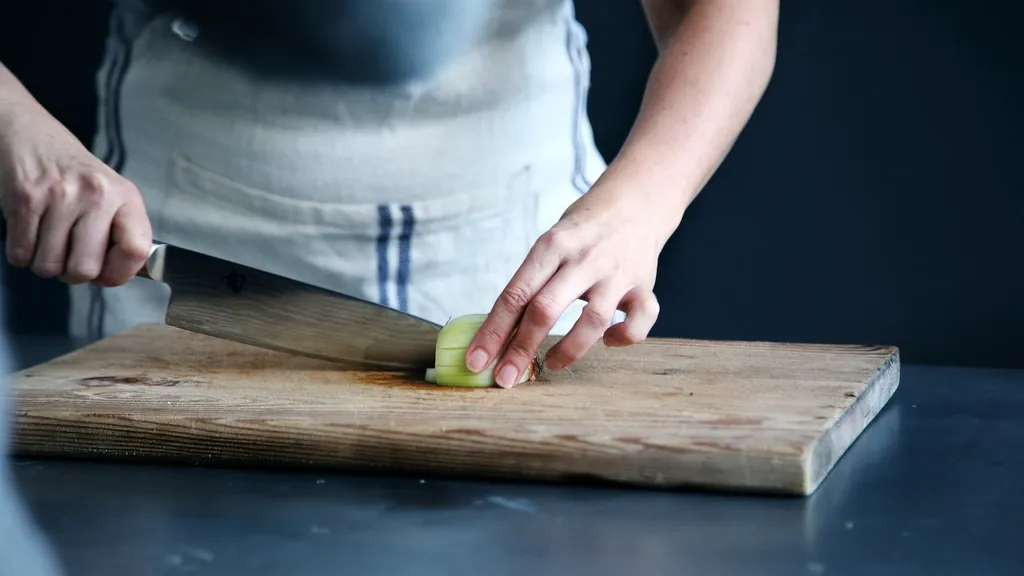
Most kitchens contain a block of six knives, of which one gets used and none are sharp. The better arrangement is one good knife, kept sharp, and the difference in daily cooking is larger than any other equipment decision.
Blunt knives are the dangerous ones
This is counter-intuitive and worth stating first. A sharp knife bites where you place it. A blunt one slides off the skin of a tomato or an onion and goes somewhere you did not choose — usually toward the hand holding the food.
Blunt knives also require force, and force plus a slip is how the serious cuts happen. The NHS advice on cuts and knife injuries is worth knowing, but avoiding the slip is the actual intervention.
Honing and sharpening are different things
Almost everyone conflates these, and it is why people believe their steel is not working.
Honing — the steel rod that came with the block — does not remove metal. It straightens the very fine edge, which folds over microscopically as you use it. It restores an edge that has bent, not one that has worn away. That is a ten-second job before each use.
Sharpening removes metal to create a new edge. That is a whetstone, a pull-through sharpener, or someone else’s service. Depending on use, a home cook needs it somewhere between twice a year and every couple of months.
If honing stops helping, the edge is gone rather than bent, and it needs sharpening.
The simplest reliable method
For most people, a whetstone is more than they will maintain and a cheap pull-through is worse than nothing — many remove metal aggressively at a fixed angle and shorten the knife’s life.
The pragmatic middle: a decent two-stage pull-through used sparingly, or a local sharpening service. Many hardware shops, markets and butchers offer it cheaply, and a professionally sharpened knife stays usable for months of honing afterwards.
If you do want to learn a stone, one medium-grit combination stone and a few minutes of practice on a cheap knife is the whole entry cost. The technique is a consistent angle, not pressure.
What blunts a knife fastest
The dishwasher. Heat, detergent and knocking against other items. Wash by hand and dry immediately; this alone extends an edge dramatically.
Glass, stone and ceramic boards. They are harder than the steel and destroy an edge in a few strokes. Wood or plastic only.
Scraping with the edge. Turning the knife over and using the spine to sweep chopped food off the board is the fix, and it becomes automatic quickly.
Storing loose in a drawer. Edges knock against everything. A magnetic strip, a blade guard, or a block keeps the edge off other metal.
Which knife, if you are buying one
A chef’s knife between 18 and 21 centimetres does the overwhelming majority of kitchen work. Add a small paring knife and a serrated bread knife and the set is complete for most households.
Expensive is not required. What matters is that it feels balanced in your hand, the handle is comfortable when wet, and it is a steel that takes an edge — which most decent knives are.
Very hard steels hold an edge longer but chip more easily and are harder to sharpen at home. For most people a mid-range knife sharpened more often is the better arrangement.
How you hold it matters as much as the edge
A sharp knife used badly is still slow, and the grip most people learn from nobody is the limiting factor.
Hold the handle with three fingers and pinch the blade itself between thumb and forefinger, just forward of the handle. It feels wrong for about a day and then gives noticeably more control, because you are steering the blade rather than waving the handle.
The other hand curls the fingertips under, knuckles forward, so the flat of the blade rests against the knuckles as a guide. The fingertips are then physically behind the cutting edge rather than in front of it. Both hands together are why professionals cut fast without looking worried — it is technique, not bravery.
Food safety and cutting technique overlap here too: separate boards for raw meat and for ready-to-eat food is the standard advice from the Food Standards Agency, and a knife moving between them without a wash is the usual cross-contamination route.
Test it honestly
The paper test: hold a sheet of paper by one corner and slice down through it. A sharp knife cuts cleanly with no pressure. A blunt one tears or slides.
Do this occasionally rather than assuming. Edges degrade gradually enough that you adapt without noticing, which is why people are surprised by how much easier cooking becomes after sharpening.
The habit
Hone before use. Wash and dry by hand. Wood or plastic boards. Scrape with the spine. Store off other metal. Sharpen properly two to four times a year.
That is most of the maintenance, and it turns one knife into better equipment than a block of six.
More cooking in Food & Cooking, including why food sticks to your pan.