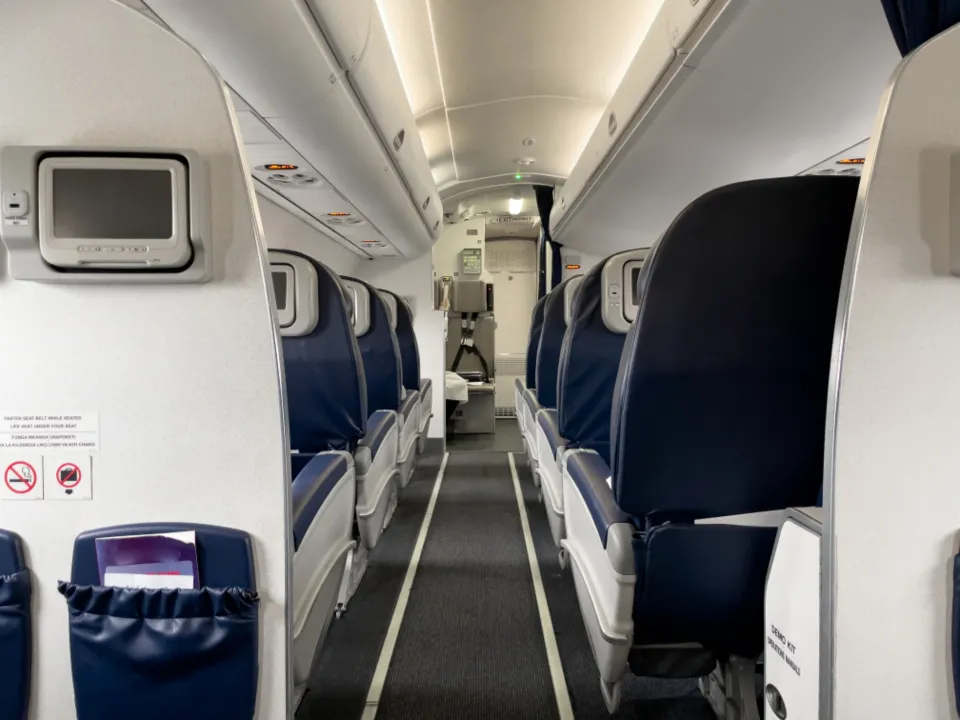
Most people choose a seat on one axis — window or aisle — and then wonder why one flight was fine and the next was miserable in the same kind of seat. The axis that actually decides it is which row.
Window or aisle, settled quickly
Window if you intend to sleep. Something to lean on, control of the blind, and nobody climbing over you at three in the morning.
Aisle if you are tall, drink a lot of water, or cannot sit still. You can stand whenever you like without negotiating with two strangers.
Middle is worse than both, with one exception: on a three-seat row where you are travelling as a pair, booking the window and the aisle often leaves the middle empty until the flight fills. If it does fill, you swap and lose nothing.
That is genuinely the whole window-versus-aisle question. The rest matters more.
The rows to avoid
The row in front of an exit row. Frequently does not recline, because the seat behind must stay clear. You will not be told this when booking and you will notice it for eleven hours.
The last row. Usually against a bulkhead, often non-reclining, and next to the toilets — meaning a queue beside your head, a door opening all night, and the light from the galley.
Anything adjacent to a galley. Crew work there for the whole flight, with lights on and carts moving. Fine for a two-hour hop, punishing overnight.
Bulkhead rows, if you want your bag within reach. There is no seat in front, so there is no under-seat storage — everything goes overhead for takeoff and landing.
The rows worth paying for, and the ones that are free
Exit rows have the most legroom in economy by a wide margin. You must be willing and able to operate the door, cannot have a bag at your feet during takeoff, and some airlines charge for them. Often the best value seat on the aircraft.
Bulkhead rows also have extra legroom but you cannot stretch your feet under anything, and they are frequently allocated to families with infants because that is where bassinets attach.
The row just behind an exit row sometimes gets residual space at no cost. Worth checking the seat map for.
Front of the cabin gets served first and gets off first. On a tight connection that is worth more than legroom.
Read the seat map before you pick
Airlines publish a seat map at booking, and it marks exits, galleys and toilets. Two minutes with it prevents most of the problems above.
What it will not always show is whether a specific seat has a missing window, a misaligned window, or reduced recline. Independent seat-review sites cover that per aircraft type, and they are worth a look on a long flight — the aircraft type is on your booking confirmation.
Check the aircraft again a few days before departure. Equipment swaps are common, and a swap can move your carefully chosen seat next to a toilet.
If you are travelling with someone
Book together in one transaction where you can. Airlines are not obliged to seat companions together otherwise, and separate bookings are frequently split.
If you are separated at check-in, ask at the gate rather than at the desk. Gate staff have the final seat map and far more flexibility once no-shows are known.
Consumer regulators have taken an interest in seat fees for families specifically — the US Department of Transportation’s aviation consumer protection pages set out current expectations on seating children with an accompanying adult, and it is worth knowing before paying to makes it much more likely it.
What the seat map does not tell you about the aircraft
Two rows with identical legroom can feel very different depending on the aircraft.
On many single-aisle jets the rear cabin narrows, so the last few rows are marginally tighter across the shoulders even where the seat pitch is unchanged. On wide-bodies, the outer seats in a three-four-three layout sit under the curve of the fuselage, which costs a little shoulder room by the window.
Cabin noise varies too. Anywhere forward of the engines is quieter than anywhere behind them, which on most modern aircraft means the front half of the cabin is noticeably calmer overnight.
None of these outweigh avoiding a galley or a non-reclining row, but between two otherwise equal options they are a reasonable tie-breaker. Airlines publish their seat configurations, and the US Department of Transportation requires certain seat dimension information to be disclosed.
Paying for a seat, or not
For a short daytime flight, seat selection is usually not worth the fee — you are sitting down for ninety minutes.
For anything overnight, anything over about six hours, or any flight where a bad seat would genuinely ruin the next day, an exit row is one of the cheaper comfort improvements available.
The middle case is the tight connection, where being at the front of the cabin can be the difference between making it and not.
The two-minute routine
Open the seat map. Avoid the row before an exit row, the last row and anything by a galley or toilet. Pick window if you plan to sleep, aisle if you plan to move. Consider an exit row on anything long. Re-check the aircraft type a few days before you fly.
More in Travel, including what to do when a flight is cancelled and packing a carry-on for a week.