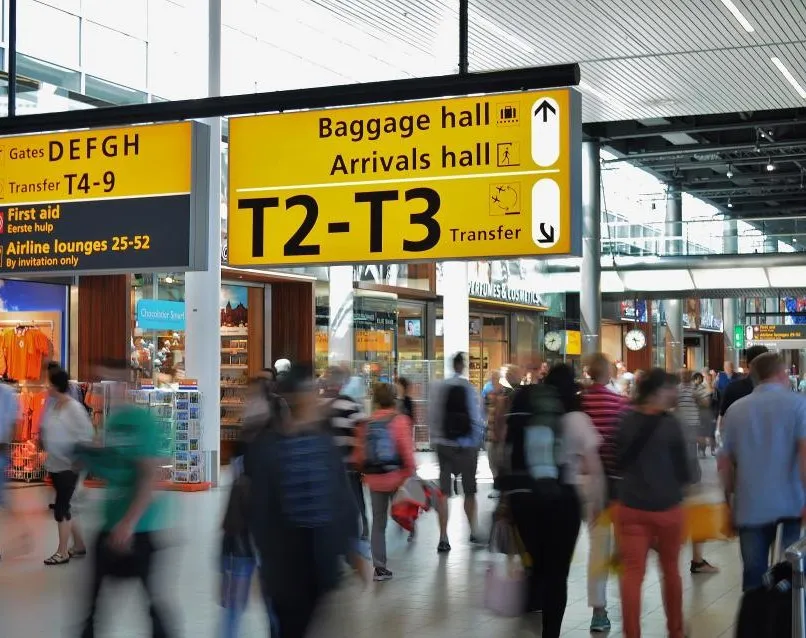
A cancellation is announced and roughly two hundred people do the same thing at the same time: they stand up, look at the board, and walk toward the airline desk. Within ninety seconds the queue is forty minutes long, and every seat on the next flight is being allocated to the people at the front of it.
Almost nothing about the next few hours is under your control. The first ten minutes are the exception, and what you do with them decides whether you are on the evening flight or the one tomorrow lunchtime.
Get in two queues at once
The single most useful habit: join the physical queue, and while standing in it, open the airline’s app and call the airline’s phone line. All three are routes to the same rebooking system, and they move at completely different speeds.
The desk agent has the shortest queue in front of them but the longest per-person handling time. The app is instant but only offers you what its rules allow. The phone line is often answered by a different team entirely, sometimes in another time zone, sometimes not busy at all.
Whichever gets there first wins, and you can abandon the other two. Doing them in sequence — trying the app, giving up, then joining the queue — is how people end up last in every line.
If the airline has a lounge or a transfer desk elsewhere in the terminal, those agents can usually rebook you too, and almost nobody walks to them.
Know what you are entitled to before you ask
Rebooking is a negotiation where one side knows the rules and the other usually does not. What you are owed depends almost entirely on where you are flying and with whom.
In the European Union and the UK, cancellations inside a defined notice period carry a right to rerouting and, depending on the cause and the delay at arrival, to cash compensation. The European Commission’s plain-language summary of air passenger rights is worth reading once before you ever need it.
In the United States the picture is different: the Department of Transportation’s aviation consumer protection pages set out what airlines must do, including refunds when a flight is cancelled and you choose not to travel.
The point is not to recite regulation at a tired agent at eleven at night. It is that “can you reroute me on another carrier?” is a much better question when you already know it is sometimes an obligation rather than a favour.
Ask a better question than “what can you do?”
Agents work fastest when you hand them a solution to check rather than a problem to solve.
Before you reach the front, look up the actual alternatives yourself: later flights on the same airline, flights on partner airlines, flights from a second airport within reach, and routes with one connection instead of a direct. Then arrive with something specific — “is there space on the 19:40 via Munich, or the direct tomorrow at 07:00?”
This changes the interaction completely. You are no longer asking someone to search on your behalf while forty people watch; you are asking them to confirm two options and pick one.
The alternative airport is the most-missed option
Travellers rarely think of it, so seats are still available there long after the obvious flights have filled. If a second airport is ninety minutes away by train and the alternative is a night on a terminal floor, it is usually the better trade.
Deal with the night before you deal with the flight
If it becomes clear you are not flying today, stop working on the flight and book a room. Hotel availability near an airport collapses within about an hour of a mass cancellation, and it collapses faster than the rebooking queue moves.
Book something refundable, keep working the rebooking, and cancel the room if a seat appears. A refundable booking you did not need costs nothing. A room you did not book at midnight costs a great deal.
Keep every receipt from this point onward — meals, transport, accommodation. Where reimbursement applies, it is generally paid against documented expense rather than as a flat amount, and a photo of each receipt taken at the time is worth more than a memory of what you spent.
What to do the following week
Claims are rejected far more often for missing detail than for being unjustified. When you write, include the booking reference, the flight number, the scheduled and actual times, what the airline told you the cause was, and what you spent.
Send it once, keep it factual, and give them the reference number they need to look it up. If you get nowhere, most countries have a national enforcement body for passenger rights, and the airline knows it.
The short version
Three queues at once. Know the rules before you ask. Bring a specific alternative rather than a question. Book the room early. Keep the receipts.
None of it makes a cancellation less annoying. It usually makes it shorter.
More practical guides are in our Travel section, including documents to photograph before you travel.